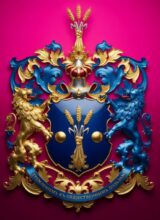


THE TERESHCHENKO SUGAR EMPIRE
How a Ukrainian Dynasty Built One of the Great Industrial Fortunes of Imperial Europe
There was a time when sugar was not an ordinary item sitting unnoticed on a kitchen shelf.
It was an industry of extraordinary strategic importance — a commodity capable of creating fortunes, transforming cities, financing banks and railways, employing thousands of people, and turning agricultural regions into powerful industrial centers.
And in nineteenth-century Ukraine, few names became as closely associated with that transformation as Tereshchenko.
From the historic Ukrainian city of Hlukhiv, once a capital of the Cossack Hetmanate, the Tereshchenko family rose from merchants and agricultural traders into one of the most powerful entrepreneurial dynasties of the Russian Empire. Their factories processed enormous quantities of sugar beet. Their estates stretched across vast territories. Their commercial offices connected Ukrainian production with markets far beyond the empire. Their products appeared at major exhibitions. Their fortune financed hospitals, schools, universities, museums, churches and cultural institutions whose buildings still shape Ukrainian cities today.
By the beginning of the twentieth century, the Tereshchenkos were no longer simply merchants who happened to own several factories.
They had created a sugar kingdom.
At different moments the family controlled around a tenth of the sugar produced in the entire Russian Empire, while owning some of its largest agricultural estates and industrial enterprises. By the turn of the century they held approximately 140,000 desiatinas — about 153,000 hectares — of land, placing them among the empire’s major landowners.
Their story is not merely the story of extraordinary wealth.
It is the story of the emergence of Ukrainian industrial capitalism.
FROM HLUKHIV TO AN INDUSTRIAL DYNASTY
The origins of the Tereshchenko fortune were remarkably different from the aristocratic fortunes of Europe’s old hereditary nobility.
The family did not begin with centuries of enormous landed estates.
They built their capital.
The founder of the business dynasty, Artemii Yakovlevich Tereshchenko, established himself as a successful merchant in Hlukhiv. The family traded grain and other goods, and during the Crimean War of 1853–1856 government supply contracts helped increase their available capital substantially. That money would soon be redirected into an industry whose potential the family understood exceptionally well: beet sugar.
The timing was crucial.
During the nineteenth century, sugar production was undergoing a revolution. Europe was learning how to produce sugar on a vast scale from sugar beet rather than relying exclusively on imported tropical sugar cane.
Ukraine possessed several enormous advantages: extraordinarily fertile agricultural land, a climate suited to beet cultivation, a large labor force and proximity between farms and processing facilities.
The center of beet cultivation and sugar production consequently shifted increasingly toward Ukrainian territories. Ukrainian encyclopedic research notes that during the nineteenth century a major network of sugar factories, beet-growing farms and eventually breeding stations developed there.
The Tereshchenkos saw what this could become.
And they moved aggressively.
SUGAR: THE INDUSTRY THAT CHANGED UKRAINE
The Tereshchenkos were part of a remarkable generation of Ukrainian entrepreneurs that included the Symyrenko, Yakhnenko, Kharytonenko, Brodsky and Khanenko families.
Some of these industrialists entered sugar production earlier. The Yakhnenko-Symyrenko enterprise, for example, constructed an advanced steam-powered sugar refinery in the 1840s.
The achievement of the Tereshchenkos was therefore not that they invented Ukrainian sugar manufacturing.
Their achievement was something different — and ultimately enormous.
They helped transform it into industrial-scale capitalism.
They combined agriculture, land ownership, factory production, refining, financing, logistics and international trade into an increasingly integrated business system.
Modern economic historians describe precisely this development as one of the reasons Ukrainian sugar manufacturers became internationally competitive: rather than merely selling grain or sugar beet, entrepreneurs moved further along what today would be called the value-added chain, processing agricultural raw materials into finished commodities themselves.
The Tereshchenkos were masters of that model.
They did not simply buy sugar beet.
They owned the land on which beet was cultivated.
They did not simply sell raw sugar.
They controlled factories and refineries.
They financed other producers.
They operated trading organizations.
They distributed the finished product.
And eventually they sold it far beyond Ukraine.
This was not simply farming.
It was an industrial system.
THE GREAT EXPANSION AFTER 1861
One of the decisive moments came after the emancipation reform of 1861.
Economic restructuring created serious difficulties for many traditional landowners. Estates and industrial facilities became available for purchase or lease.
The Tereshchenkos had capital.
And they knew exactly what to do with it.
They acquired or leased estates and older sugar plants, modernized production and expanded beet cultivation.
According to Ukraine’s Central State Historical Archives, by 1870 Mykola Tereshchenko alone owned more than ten sugar and refining enterprises around Hlukhiv together with roughly 80,000 desiatinas of land, as well as distilleries, steam and water mills, brickworks and repair facilities spread across several gubernias of the empire.
It was becoming something far larger than a collection of factories.
It was becoming an empire.
And at its center stood the three sons of Artemii Tereshchenko:
Mykola, Fedir and Semen Tereshchenko.
1870: THE TERESHCHENKO BROTHERS BUILD THEIR CORPORATE EMPIRE
In 1870, the family established the enterprise that would become synonymous with its industrial power:
The Tereshchenko Brothers’ Association of Beet-Sugar and Refinery Factories
Its initial capital was an extraordinary 3 million rubles.
The figure alone reveals the scale at which the family was already operating.
But the organization itself was equally important.
Instead of allowing family wealth to fragment into disconnected enterprises, the Tereshchenkos were using an organizational structure capable of pooling capital, coordinating factories, investing in technology and expanding production.
The Ukrainian National Academy of Sciences describes the family as an important innovator in adopting new corporate organization and using capital to acquire Western technologies and improve production.
This is what made the Tereshchenko enterprise strikingly modern.
Imagine the company not simply as a nineteenth-century sugar mill but as an early industrial group.
Agricultural estates supplied raw material.
Factories processed it.
Refineries increased its value.
Trading offices distributed it.
Financial operations supported both family factories and other producers.
Capital was reinvested into machinery, land and expansion.
The family business had begun to resemble what a century later would be called a vertically integrated corporation.
MYKOLA TERESHCHENKO — THE ARCHITECT OF THE SUGAR KINGDOM
Among the members of the dynasty, Mykola Artemiiovych Tereshchenko emerged as one of its greatest industrial organizers.
His influence extended far beyond factories formally registered in his own name.
A nineteenth-century economist cited by Ukraine’s Central State Historical Archives described an extraordinary financial network in which other sugar producers received Tereshchenko capital to operate their factories and then marketed sugar through the Tereshchenko commercial organization.
In other words, Mykola Tereshchenko was functioning not only as a manufacturer.
He was functioning as a financier of the industry itself.
That distinction matters.
Owning factories makes someone an industrialist.
Financing an entire industrial ecosystem makes someone something closer to an economic institution.
Tereshchenko capital helped factories operate, expand and, in some cases, even be constructed.
The family’s influence therefore exceeded the number of smokestacks carrying their name.
FACTORIES, ESTATES AND AN INDUSTRIAL LANDSCAPE
Across Ukrainian territories, enormous beet fields fed increasingly mechanized factories.
Places that had once been predominantly agricultural became industrial settlements.
The Tereshchenkos developed major enterprises at locations including Andrushivka and Chervone, among numerous others.
At Andrushivka, an earlier juice-processing facility was transformed in the 1870s into a large and highly mechanized sugar plant. Contemporary regional historical material records more than a thousand workers there by the mid-1870s.
Multiply this pattern across the family’s properties and the true economic importance becomes clearer.
Every sugar factory required much more than a factory building.
It required thousands of hectares of beet cultivation.
Roads.
Warehouses.
Machinery.
Engineers.
Agronomists.
Mechanics.
Carpenters.
Transport workers.
Administrative staff.
Commercial representatives.
And enormous quantities of capital.
A sugar refinery therefore functioned as the center of an entire economic ecosystem.
The Tereshchenkos were helping industrialize the Ukrainian countryside itself.
TEN PERCENT OF AN EMPIRE’S SUGAR
By the beginning of the twentieth century, the scale had become remarkable.
Research on Ukrainian sugar associations estimates that the Tereshchenko family controlled 11 sugar factories producing as much as approximately 10 percent of the sugar of the entire Russian Empire.
Ten percent.
From one family industrial network.
To understand what that meant, remember that the Russian Empire itself had become one of the world’s major beet-sugar producers.
At the Paris Exposition Universelle of 1900, the empire’s sugar industry represented roughly 17 percent of global sugar production, according to research published in History of Science and Technology. And many of its largest sugar enterprises were concentrated on the territory of modern Ukraine.
That places the Tereshchenkos within a genuinely international industrial story.
Their factories were not merely important to Hlukhiv.
Not merely important to Kyiv.
Not merely important to Ukraine.
They were part of one of the world’s major sugar-producing systems.
FROM UKRAINIAN BEET FIELDS TO INTERNATIONAL MARKETS
And the sugar did not remain inside the empire.
Tereshchenko products entered European and Asian markets.
Research published by the National Academy of Sciences of Ukraine describes the family’s products moving first throughout the Russian Empire and later into European and eastern markets, including destinations such as China and Afghanistan.
Other historical accounts describe sales extending toward countries including Britain, Germany, Switzerland and Norway, as well as Persia and Afghanistan.
The transformation is extraordinary.
Sugar beet was grown in Ukrainian soil.
It was harvested and transported to Tereshchenko factories.
There it was processed through increasingly sophisticated industrial equipment.
It became refined sugar.
And eventually that Ukrainian-produced commodity traveled through international commercial networks toward consumers thousands of kilometers away.
The family from Hlukhiv had become part of global trade.
QUALITY AS A BUSINESS WEAPON
Scale alone did not create the Tereshchenko reputation.
Quality mattered.
From an early stage, the family understood something that modern global companies still understand perfectly:
A powerful brand depends on consistency.
Their sugar and refined products repeatedly appeared at major industrial exhibitions.
At the 1870 All-Russian exhibition, the Tereshchenko enterprise received a silver medal for the quality of its granulated and refined sugar and the scale of its production.
Their products continued to receive recognition at later exhibitions, including international ones.
Tereshchenko products were associated with the Paris exhibition of 1878, and by the end of the century family enterprises were appearing on the grandest international industrial stage of all.
At the Paris World’s Fair of 1900, Tereshchenko enterprises were officially represented among the major sugar firms displayed in the Palace of Agriculture.
The exhibition included the Tereshchenko Brothers company, representatives of the heirs of Fedir Tereshchenko, and other Tereshchenko interests alongside the leading sugar producers of the period.
Paris 1900 was no provincial trade fair.
It was one of the defining global exhibitions of the industrial age — a showcase where countries and corporations demonstrated technology, engineering, manufacturing and economic power before an international audience.
And there, among the great industrial displays of the world, stood the sugar enterprises of the Tereshchenko dynasty.
TECHNOLOGY, MANAGEMENT AND THE PURSUIT OF EFFICIENCY
The popular image of nineteenth-century industrialists sometimes reduces their success to owning land and employing inexpensive labor.
That explanation is incomplete.
Successful sugar manufacturing was technologically demanding.
Temperature, extraction, evaporation, crystallization and refining all required carefully controlled industrial processes.
Mistakes cost money.
Poor-quality beet reduced yields.
Outdated machinery consumed excessive fuel.
Bad transportation could destroy an entire production cycle.
The great Ukrainian sugar families therefore became major consumers of modern European industrial technology.
The Tereshchenkos invested heavily in modernization.
Historical economic research emphasizes their attention to production organization, cleanliness, factory layout, technology and management.
The result was not simply more sugar.
It was cheaper, more consistent and more competitive sugar.
This combination — agricultural efficiency + industrial technology + capital + management + international distribution — explains how a family enterprise could become one of the dominant manufacturers of such a vast empire.
THE TERESHCHENKOS WERE MORE THAN SUGAR MANUFACTURERS
The family’s wealth soon expanded far beyond sugar itself.
Their business interests included agricultural estates, mills, distilleries, forestry-related operations, workshops and other manufacturing enterprises.
Sugar nevertheless remained the gravitational center.
It generated capital.
Capital purchased land.
Land produced agricultural commodities.
Industrial assets transformed those commodities into higher-value products.
Profits funded further expansion.
And the cycle continued.
By the turn of the twentieth century, the Tereshchenkos owned approximately 140,000 desiatinas of land — roughly 153,000 hectares — across Ukraine and other territories of the empire.
These were not simply wealthy merchants anymore.
They had become industrial magnates.
MILLIONS OF RUBLES — AND ONE OF THE GREAT FORTUNES OF THE AGE
Any attempt to translate a nineteenth-century fortune directly into modern dollars is misleading.
The purchasing power of money, the value of land, labor costs, industrial assets and the relative concentration of wealth were radically different.
But contemporary figures still communicate something extraordinary.
The Tereshchenko Brothers company began with 3 million rubles of capital in 1870. Later accounts place its capital around 8 million rubles by 1900, with annual production valued in the tens of millions.
Other historical accounts put the company’s annual turnover above 12 million rubles.
Those numbers placed the Tereshchenkos among the great millionaire industrial dynasties of the Russian Empire and Eastern Europe.
Their fortune belonged to that tiny international class of nineteenth-century families whose economic power could be measured not merely in houses or estates, but in factories, enormous agricultural holdings, financial networks and international trade.
So when the Tereshchenkos became known as Sugar Kings, the description was not simply poetic.
It reflected industrial reality.
FROM MERCHANTS TO NOBILITY
Economic power eventually brought social recognition.
In 1870, Artemii Tereshchenko and his family were elevated into the hereditary nobility of the Russian Empire in recognition of public service and charitable activity.
For a family whose fortune had emerged through commerce rather than centuries of inherited aristocratic privilege, the transformation was remarkable.
Within several generations, the Tereshchenkos had moved from trade in Hlukhiv to the highest levels of imperial society.
Yet their family identity retained something unusual.
Their coat of arms carried the motto:
“Aspiration for Public Benefit.”
That phrase came to express the second half of the Tereshchenko story.
Because sugar created the fortune.
But philanthropy transformed that fortune into a legacy.
WHEN SUGAR BUILT SCHOOLS, HOSPITALS AND MUSEUMS
The wealth created in Ukrainian beet fields eventually reappeared in another form.
Universities.
Schools.
Hospitals.
Museums.
Art collections.
Churches.
Public buildings.
Social institutions.
Members of the Tereshchenko dynasty became some of the most important philanthropists in Ukrainian history.
Mykola Tereshchenko helped finance educational institutions in Hlukhiv and Kyiv and contributed to the development of institutions associated with what became Kyiv Polytechnic Institute. Members of the wider family supported artistic education, museums and collections that would become part of Ukraine’s national cultural heritage.
His daughter Varvara Tereshchenko Khanenko, together with her husband Bohdan Khanenko, assembled an extraordinary art collection that became the foundation of today’s Bohdan and Varvara Khanenko National Museum of Arts in Kyiv.
Ivan Tereshchenko supported artistic education.
Other family members financed civic, religious and educational projects.
The same industrial fortune that emerged from sugar beet therefore helped finance the cultural transformation of Kyiv.
Factories became museums.
Sugar became education.
Industrial capital became architecture.
A DYNASTY BUILT AROUND FAMILY
One reason the Tereshchenko empire survived and expanded across several generations was that it remained deeply familial.
The company was not simply owned by anonymous shareholders.
Brothers, sons, daughters and relatives participated in a broad network of ownership, management, investment and philanthropy.
Research into the sugar industry at the 1900 Paris World’s Fair emphasizes that many of Ukraine’s great sugar enterprises were family businesses in which ownership and management remained closely intertwined.
The Tereshchenkos exemplified that model.
Artemii created the commercial foundation.
Mykola, Fedir and Semen expanded the industrial empire.
The next generation inherited factories, estates, capital and cultural responsibilities.
It was capitalism organized around dynasty.
NOT A FAIRY TALE: THE HARD REALITY OF INDUSTRIALIZATION
The magnificence of the Tereshchenko story should not turn nineteenth-century industrialization into mythology.
Sugar production was physically demanding.
Agricultural and factory labor could be difficult, and relations between owners and workers were not always harmonious.
Some historical records emphasize comparatively extensive welfare provision at Tereshchenko enterprises — including schools and medical facilities — while other evidence records serious labor disputes at individual factories in the turbulent early twentieth century.
That complexity matters.
The industrial revolution created enormous fortunes and technological progress, but it also created new social tensions throughout Europe and the United States.
The Tereshchenko empire existed inside that larger industrial world.
Recognizing that reality does not diminish their achievement.
It makes the achievement historical rather than legendary.
UKRAINE — THE LAND BEHIND THE SUGAR EMPIRE
Perhaps the most important part of the story is geographical.
The Tereshchenko industrial miracle was inseparable from Ukraine.
The black soil.
The agricultural expertise.
The labor.
The cities.
The transportation networks.
The entrepreneurial culture.
And the rapidly modernizing sugar industry centered there.
By 1900, many of the most important sugar enterprises operating inside the Russian Empire were concentrated on the territory of present-day Ukraine.
That makes the Tereshchenko story part of a larger and often underestimated historical truth:
Ukraine possessed a powerful indigenous entrepreneurial and industrial tradition long before the Soviet period.
Industrialization did not arrive in Ukraine as a Soviet invention.
Ukrainian entrepreneurs had already created sophisticated manufacturing, agricultural, financial and international commercial enterprises during the nineteenth century.
And among the greatest symbols of that era stood the sugar dynasties.
The Tereshchenkos were one of the most formidable of them.
THE SUGAR KINGS
There is something almost cinematic about the scale of the transformation.
It begins with carts carrying goods across long roads.
Then grain trading.
Commercial contracts.
The first serious capital.
Sugar beet.
One factory.
Then another.
Estates are purchased.
Machinery arrives.
Smokestacks rise above Ukrainian fields.
Railway wagons begin carrying sugar away from factories.
Commercial offices coordinate sales.
Bank accounts grow.
Foreign buyers appear.
International exhibitions display the product.
Paris sees the Tereshchenko name.
Factories produce a significant share of the sugar consumed by an empire.
And the profits return to Ukraine transformed into hospitals, schools, universities, museums and art.
Within several generations, a merchant family from Hlukhiv had joined the economic elite of Europe.
That is why describing the Tereshchenkos merely as “wealthy landowners” misses the point entirely.
They were industrial builders.
Entrepreneurs.
Financiers.
Agricultural modernizers.
International merchants.
Philanthropists.
Collectors.
And architects of one of the greatest Ukrainian business dynasties of the nineteenth and early twentieth centuries.
THE LEGACY OF THE TERESHCHENKO SUGAR KINGDOM
Empires disappear.
Currencies collapse.
Political borders change.
Factories close.
Companies are nationalized.
Fortunes scatter across revolutions and wars.
But economic history leaves fingerprints.
The Tereshchenko legacy survives in Ukrainian architecture, museums, educational institutions, historical estates and the industrial landscape itself.
It survives in the history of Kyiv.
It survives in Hlukhiv.
It survives in Andrushivka and Chervone.
And it survives in a larger Ukrainian entrepreneurial tradition that was nearly erased from public memory during the twentieth century.
Before Silicon Valley spoke about vertically integrated companies, before modern multinational corporations became symbols of globalization, nineteenth-century Ukrainian entrepreneurs were already combining agriculture, manufacturing, finance and international trade.
The Tereshchenkos understood that wealth was created not simply by possessing raw materials, but by transforming them.
Beet became sugar.
Sugar became capital.
Capital became industry.
Industry became influence.
And influence became legacy.
For decades, the name Tereshchenko stood on factories whose smokestacks rose over immense Ukrainian beet fields and on products that traveled far beyond Ukraine.
Their enterprises supplied a vast empire.
Their sugar reached foreign markets.
Their achievements were presented before international audiences.
Their fortune elevated the family into the highest circles of European society.
And their philanthropy returned a remarkable portion of that success to the cities and communities from which the dynasty had risen.