
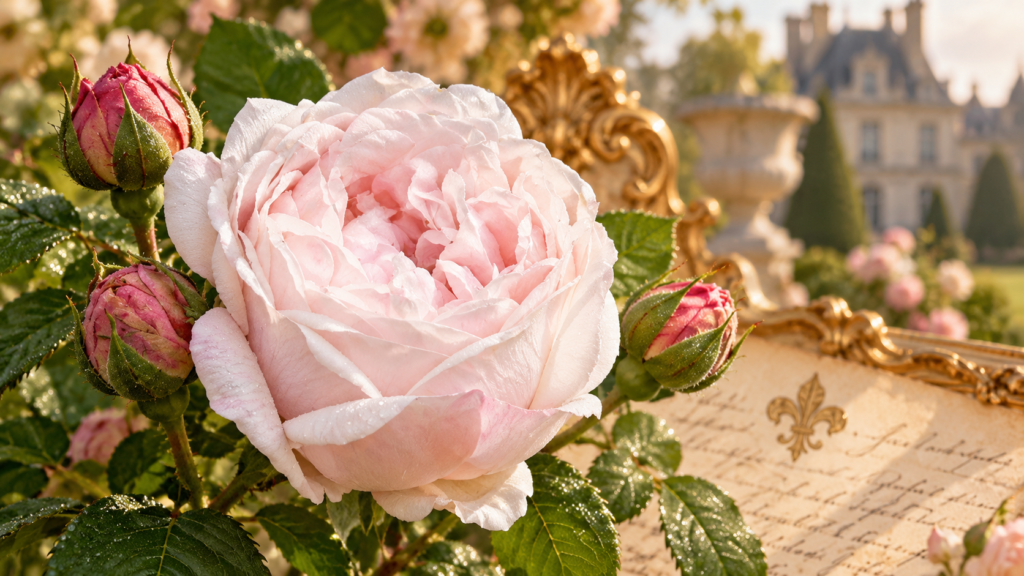
Madame Olympia Tereshchenko — The Rose Created for a Woman, a Dynasty and a Love Story
Some jewels are cut from stone. Others are grown from the earth. In 1882, in the great horticultural world of nineteenth-century France, a rose appeared bearing a name that was never intended to disappear:
Madame Olympia Tereshchenko.
Soft white touched with delicate pink, full-petalled, fragrant and unmistakably aristocratic in appearance, the flower was created by the celebrated French rosarian Louis Lévêque and named for Olympiada — Olympia Tereshchenko, wife of the wealthy Ukrainian industrialist and philanthropist Simon Artemievich Tereshchenko.
More than 140 years later, the rose survives.
Not simply as another Victorian garden variety, but as a living fragment of the Tereshchenko family story — preserved in old catalogues, specialist rose editorial collections and of course at a historic rosaria.
A flower carrying a woman’s name across centuries. And perhaps that is what makes it extraordinary.
A Rose That Was Never Meant to Be Ordinary
Today we are accustomed to walking into a flower shop and choosing among dozens of roses.
That was not what this meant in the nineteenth century.
For the elite of European society, horticulture could become an art of patronage. Estates maintained elaborate gardens, collectors competed for unusual plants, famous nurserymen cultivated new varieties, and flowers could be dedicated to aristocrats, financiers, industrialists and members of distinguished families.
To have a rose carrying one’s name was something altogether different from receiving a bouquet.
A bouquet lasted days.
A cultivar could last generations.
The rose that came to bear the name Madame Olympia Tereshchenko was introduced in France by Pierre Louis Lévêque in 1882. Lévêque was one of the notable French rosarians of his generation. His nursery operated from the Paris region, his roses travelled through the increasingly international horticultural trade, and he won awards at horticultural exhibitions. He was made a Knight of the French Legion of Honour in 1878.
Among his creations were roses named for prominent European figures and families, including Baron Nathaniel de Rothschild (from the Rothschild family directly connected to Tereshchenko), Grand Duke Alexis and members of other aristocratic houses.
Into that highly selective world entered another name:
Tereshchenko.
Simon and Olympiada
Simon Artemievich Tereshchenko belonged to the celebrated Tereshchenko industrial dynasty, a family whose enormous nineteenth-century fortune grew through sugar, manufacturing, finance and other enterprises and whose name became equally associated with philanthropy, education, culture and the arts.
Simon himself was a businessman and millionaire who headed the city bank in Hlukhiv, Ukraine and had interests in manufacturing and other enterprises.
His wife was Olympiada, remembered in French horticultural history under the elegant French form of her name:
Madame Olympia Tereshchenko
The couple married in the 1860s.
And according to Tereshchenko family tradition and later accounts surrounding the cultivar, Simon wanted something exceptional created in his wife’s honor.
Not jewelry. Not porcelain. Not simply roses.
Her own rose.
A flower bearing her name.
Simon had ordered to breed the flower specially created as a gift for his wife Olympiada and that the name is going to be Madame Olympia Tereshchenko commemorated his wife.
It is an astonishingly romantic idea even by the standards of nineteenth-century grand gestures. Because unlike diamonds or paintings, a living cultivar must be continuously preserved. Someone has to grow it. Someone has to propagate it. Someone has to care enough to prevent it from vanishing. And more than a century later, people still do.
Paris, 1882: Where Luxury Could Literally Be Cultivated
Paris during the Belle Époque and the decades leading into it had become one of Europe’s great centres of luxury culture. Fashion houses dressed Europe’s elite. Jewelers produced commissions for royal courts. Decorators furnished hôtels particuliers. Portraitists immortalized families on canvas. And beyond the salons, another highly sophisticated world flourished: horticulture.
French rose breeders were celebrities within this world. Creating a new rose demanded botanical knowledge, patience and enormous practical skill. Years could separate the original mutation or hybridization from the moment a cultivar was sufficiently stable to be introduced.
Louis Lévêque had trained in his father’s horticultural establishment before entering business himself. The family operation eventually moved to Ivry-sur-Seine, near Paris, and Lévêque became known particularly for remontant roses, peonies and clematis. Contemporary and later records credit him with a prolific output of new roses.
Commissioning or receiving a dedicated cultivar therefore belonged to the same broad world of private portraiture, specially designed jewelry, custom carriages and bespoke interiors. It represented something money could buy — but ordinary commercial consumption could not reproduce.
The true luxury was individuality.
There could be thousands of roses. But only one could bear her name.
The Birth of Madame Olympia Tereshchenko
The cultivar entered horticultural history in 1882.
A surviving French rose inventory from the beginning of the twentieth century records: Olympia Tereshchenko, 1882 — blanc rosé.
In other words: a pinkish-white rose created by Lévêque and already established sufficiently in horticultural literature to be formally catalogued.
Specialist modern sources identify the plant as a historic Bourbon-type rose, often described as a sport — a naturally occurring mutation — of the famous Bourbon rose Louise Odier.
There is some variation in historical classification. Some records place it among hybrid perpetuals, while specialist heritage-rose collections classify it as Bourbon or Bourbon/remontant. This sort of disagreement is not unusual for nineteenth-century roses whose classifications evolved over time.
What Does the Tereshchenko Rose Look Like?
The beauty of Madame Olympia Tereshchenko is not theatrical.
It is refined.
Its palette moves through extremely delicate shades — essentially white washed with soft pink, sometimes deepening toward light carmine or blush tones.
Historic cataloguing described it simply and elegantly as blanc rosé — pinkish white.
Later specialist descriptions portray the flower as full and double, approximately 17–25 petals, often appearing in clusters rather than merely as solitary blooms. The color can vary from almost porcelain white through pale blush and soft carmine-pink depending on the bloom and stage of flowering.
The effect is remarkably similar to the aesthetic of nineteenth-century portraiture: ivory skin, pink silk, powdered blush, pearl, and satin. Not loud. Not modern. Not engineered for shocking color. It looks like something that belongs beside a handwritten letter.
The Flower
The blossoms possess the rounded, layered form associated with old European garden roses.
Unlike many modern roses bred primarily for long stems and commercial transport, nineteenth-century varieties were valued for qualities such as character, fragrance, garden presence and individual flower form.
Madame Olympia Tereshchenko has been described as carrying a pleasant or moderate old-rose fragrance. Specialist sources also record repeat flowering, another desirable characteristic associated with its remontant ancestry.
The plant has additionally been described as vigorous, floriferous and relatively hardy, with pale green stems bearing few thorns and dark green serrated foliage.
Even botanically, therefore, it has an intriguing quality. Delicate flower. Strong plant. There is something rather fitting about that.
Why the Tereshchenko Rose Is Rare
Here the story becomes even more fascinating.
Thousands upon thousands of rose cultivars have been created since the nineteenth century.
Most disappear.
Fashion changes. Nurseries close. Wars destroy gardens. Collectors die. Commercial growers replace older varieties with new ones. A cultivar that is no longer commercially profitable can quietly vanish within a few decades.
Historic roses survive because someone keeps propagating them. That makes every surviving nineteenth-century cultivar something of a botanical archive.
And Madame Olympia Tereshchenko is now specifically described by heritage-rose growers as a very rare rose.
Rosenpark Reinhausen in Germany, for example, calls it a “very rare and interesting rose” and records its material as originating from the celebrated historic Roseraie de L’Haÿ rose collection in France.
The Roseraie de L’Haÿ — now associated with L’Haÿ-les-Roses — belongs to the great tradition of historic European rose preservation. For a rose introduced in 1882 to remain identifiable today means that generations of horticulturists kept it alive. Every surviving plant therefore descends through propagation from that nineteenth-century cultivar. The rose is not a replica. It is not a rose merely chosen because it resembles the original. Botanically, a cultivar maintained through vegetative propagation is a continuation of that same named genetic line.
In that sense, a living Madame Olympia Tereshchenko today is literally a surviving piece of 1882.
A Luxury Greater Than a Bouquet
It would be misleading to claim that every surviving plant today necessarily costs a fortune; historic roses occasionally circulate among specialist nurseries and collectors.
But the original gesture belongs unquestionably to a world of exceptional privilege.
Commissioning, patronising or obtaining a custom rose from one of France’s respected nineteenth-century breeders was not equivalent to purchasing flowers from a shop. It required access. It required time. It required horticultural connections. And, inevitably, considerable wealth.
The nineteenth-century ultra-wealthy rarely defined luxury solely through price. They defined it through things other people could not simply walk into a store and duplicate.
A bespoke gown.
A private railway carriage.
A commissioned portrait.
An architect-designed mansion.
A jewel created for one woman.
Or a flower that did not exist until someone decided it should. That is where the Tereshchenko Rose belongs. Its luxury is not that every specimen must today carry an astronomical price tag. Its luxury lies in its conception:
a man of immense means asking one of France’s accomplished rosarians to make his wife’s name bloom.
Money could buy roses. Extraordinary money and connections could create your own rose.
The Tereshchenko Tradition of Beauty
The story also fits naturally within the wider cultural world inhabited by the Tereshchenko dynasty. The family became famous not merely for industrial wealth but for what it did with wealth.
Members of the family collected major artworks, supported museums, churches, hospitals, educational institutions and charitable initiatives, and participated in European cultural life.
Taste mattered.
Beauty mattered.
Patronage mattered.
Creating a rose dedicated to a family member therefore seems far less eccentric when understood within nineteenth-century elite culture.
Art could hang on a wall. Architecture could transform a city. Jewelry could move through generations.
A rose could turn memory into something alive.
And the most extraordinary luxury objects often operated precisely that way: they transformed private affection into heritage.
The Rothschild Connection and the Fashion for Named Roses
Louis Lévêque’s career places the Tereshchenko rose within an even broader culture of flowers named for Europe’s prominent families.
Among Lévêque’s surviving cultivars is Baron Nathaniel de Rothschild, introduced in the same year — 1882.
Other nineteenth-century breeders likewise created roses bearing names linked to leading financiers, aristocrats and society figures.
This was far more than horticultural marketing. Names acted as social monuments. Before celebrity perfumes and designer collaborations existed, gardens performed a similar cultural function. To walk through a major rose collection was almost to walk through European society itself: princesses, duchesses, industrialists, generals, bankers, artists, patrons, and society women — immortalized in petals.
Yet Madame Olympia Tereshchenko possesses something especially intimate.
The name does not commemorate a military victory or political office.
It commemorates a woman.
And behind that name lies a marriage.
Olympiada: The Woman Inside the Flower
Historical nomenclature transforms people into labels surprisingly quickly. A name appears in a catalogue. A date follows. Then a breeder. And the human being can disappear behind the botanical record. But Madame Olympia Tereshchenko was a real woman.
She walked through nineteenth-century Europe. She had a family. She belonged to a world of salons, estates, travel, fashion and enormous social change. And somewhere within that life, her husband chose a peculiar form of immortality for her. He did not merely have her portrait painted. He associated her identity with a living organism. Every spring when that plant awakened, the name returned. Every flowering repeated it. Every cutting carried it elsewhere.
France.
Germany.
Private gardens.
Historic collections.
More than a century after Simon and Olympiada were gone, horticulturists who had never met either of them still spoke the words:
Madame Olympia Tereshchenko.
That may be one of the strangest and most beautiful forms of immortality humans have invented.
The Rose Survived the World That Created It
Consider everything that happened after 1882. Empires collapsed. Borders disappeared and returned. Two world wars devastated Europe. The Russian Empire vanished. Revolution transformed the world in which the Tereshchenko family had lived. Family properties were illegally nationalized or dispersed. Fortunes illegally changed hands. Entire aristocratic and industrial cultures disappeared. Gardens were abandoned. Archives were held by occupants. Collections were scattered. Yet somehow this tiny genetic inheritance persisted. A gardener propagated it. Then another. Then another. One plant became several. Some were lost. Others survived. And today photographs still show a pale pink rose opening its layered petals under the same name recorded in France more than a century ago. There is something almost defiant about it. History can destroy mansions. History could not entirely destroy the living flower.
A Botanical Heirloom
This is perhaps the best way to understand the Tereshchenko Rose today:
not as a commercial rose, but as a botanical heirloom.
A historic diamond survives because nobody cuts it apart. A painting survives because museums control its environment. A document survives in an archive.
But plants demand something much more demanding. They must continuously live. A rose cannot simply be placed in a vault for 140 years. Without gardeners, it dies.
The survival of Madame Olympia Tereshchenko therefore represents an uninterrupted chain of human attention. Someone always cared enough to keep one plant alive. And that makes rarity particularly meaningful. There may never again be millions of these roses. There probably never were. That is part of their charm.
Not Everything Expensive Is Luxury
Modern culture tends to measure luxury with numbers.
€10,000.
€100,000.
€1 million.
But genuine historical luxury frequently operated according to another principle:
rarity + craftsmanship + individuality + provenance.
By that definition, the Tereshchenko Rose belongs comfortably in the world of luxury.
Its value is not best expressed on a price tag. Its value lies in the story embedded inside it. It was created during one of the golden periods of French rose breeding. It carries the name of a woman from one of Ukraine’s most prominent industrial dynasties. It was introduced by a notable French rosarian. It appears in historic European rose literature. It survived into modern heritage collections. And it remains rare.
There may be diamonds more expensive. There are certainly flowers more commercially fashionable. But there are remarkably few living things that can tell a family love story dating to 1882.
A Rose Made for One Woman
The most beautiful way to understand Madame Olympia Tereshchenko may ultimately be the simplest. Simon Tereshchenko was wealthy enough to buy almost anything. And so ordinary things were not enough. He could have purchased a magnificent bouquet. Instead, tradition remembers him as wanting something that did not yet exist. A rose for Olympiada. A rose carrying her name. A rose that could be replanted long after the original bouquet would have disappeared.
Perhaps that was the point.
A flower eventually dies.
A variety can become a legacy.
Madame Olympia Tereshchenko — Botanical Profile
Name: Madame Olympia Tereshchenko
Common family reference: Tereshchenko Rose
Breeder: Pierre Louis Lévêque
Country: France
Introduction: 1882
Historic color description: Pinkish white (blanc rosé)
Classification: Usually described by heritage-rose specialists as Bourbon/Bourbon-remontant; some historical sources classify it among hybrid perpetuals.
Origin: Widely recorded as a sport of Louise Odier.
Flower: Full/double, approximately 17–25 petals in later descriptions.
Color: White, blush pink to light carmine-pink.
Fragrance: Moderate to good old-rose fragrance.
Flowering: Repeat/remontant flowering.
Status: Very rare historic cultivar; documented in contemporary European heritage-rose collections.
Named for: Olympiada Viktorovna Tereshchenko, wife of Simon Artemievich Tereshchenko.
The Flower That Refused to Disappear
There is a beautiful irony in the survival of the Tereshchenko Rose.
Human beings spend fortunes trying to create permanence. They build palaces. Erect monuments. Commission statues. Collect masterpieces. Yet sometimes history preserves the smallest thing.
A pale pink rose.
In 1882, it entered the world carrying the name Madame Olympia Tereshchenko.
The century that followed tried very hard to destroy the world from which it came. It failed completely. The rose still blooms. And every time it does, Olympiada’s name blooms with it.
The Tereshchenko Rose is therefore more than a rare flower.
It is a love letter written in horticulture.
A luxury object made alive.
A family heirloom without a jewelry box.
And one of those extraordinary historical creations whose true value cannot be measured simply by asking how much it costs. Because in an age when almost anything can be purchased — having a flower created for the woman you love remains one of the rarest luxuries imaginable.