Wealth, Secret Societies, European Dynasties and the Hidden Politics the most influential family in Europe
From the sugar empire of Hlukhiv and Kyiv to the secret political networks of Saint Petersburg, the Tereshchenkos occupied an extraordinary position at the intersection of capital, philanthropy, nobility, diplomacy and power. In Mikhail Tereshchenko, that world entered one of the most mysterious political organizations of the final years of Imperial Russia.


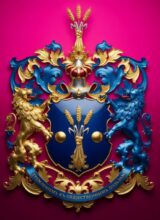
Above: the Tereshchenko family in the early twentieth century; the family coat of arms; and Mikhail Ivanovich Tereshchenko.
A DYNASTY POWERFUL ENOUGH TO ENTER THE INNER CIRCLES OF AN EMPIRE
Long before Mikhail Tereshchenko entered the secret political world of early twentieth-century Freemasonry, his family had already achieved something remarkable.
The Tereshchenkos originated as a Cossack-burgher family from the Hlukhiv region of present-day Ukraine. During the nineteenth century, Artem Tereshchenko and his sons transformed commercial success into an immense industrial and agricultural empire. Sugar became the dynasty’s most famous business, but its interests extended across land, manufacturing, finance and commerce.
By the beginning of the twentieth century, the family possessed approximately 140,000 desiatins — around 153,000 hectares — of land and ranked among the largest landowning families in the Russian Empire. In 1911–1912 alone, the dynasty controlled ten major sugar refineries.
The transformation was astonishing: from a Ukrainian Cossack-burgher lineage to hereditary imperial nobility, industrial magnates, art collectors, philanthropists and participants in the highest political circles of Europe.
And unlike the stereotype of a nineteenth-century fortune built merely for private luxury, the Tereshchenkos deliberately constructed a public identity around philanthropy.
Their heraldic motto expressed it perfectly:
“Aspiring for the Common Good.”
Mykola Artemiyovych Tereshchenko received hereditary nobility, rose to the rank of Privy Councillor and was decorated with major imperial honors as well as the French Legion of Honour. The Vernadsky National Library of Ukraine emphasizes that many of these distinctions were connected with his extraordinary charitable activity.
Schools, hospitals, museums, educational institutions, churches and cultural projects carried Tereshchenko money.
This combination — enormous independent wealth, international education, philanthropy, political access and social prestige — would later make the younger Mikhail Tereshchenko almost perfectly suited to the particular form of political Masonry that emerged in late Imperial Russia.
THE OTHER RUSSIA: A SECRET POLITICAL WORLD BENEATH THE IMPERIAL STATE
Freemasonry in the Russian Empire had a long and complicated history.
But the organization into which Mikhail Tereshchenko entered in the early twentieth century was not simply the ceremonial Freemasonry familiar from images of aprons, compasses, temples and elaborate initiations.
Something rather different had evolved.
After 1910, historians identify a clandestine organization usually described as the Masonry of the Peoples of Russia and later associated with the Grand Orient of Russia’s Peoples.
And this is where the story becomes fascinating.
Historian Barbara T. Norton, writing in the International Review of Social History, describes the organization as extraordinarily secretive. Members swore themselves to secrecy; contemporaries recalled rules against keeping written records. The organization managed for years to remain remarkably difficult for even the imperial political police to penetrate.
Alexander Kerensky later described it as an “irregular Masonic organization.”
It had abandoned much of traditional Masonic ritual and the conventional hierarchy of degrees. Women could be admitted. Its emphasis was not primarily ceremonial mysticism but political coordination, personal trust and secrecy.
This distinction matters enormously.
Calling it simply a “Masonic lodge” can actually understate what it had become.
It was closer to a confidential political fraternity linking influential individuals who otherwise belonged to different — sometimes competing — parties and institutions.


The first image is an illustrative historical depiction of an earlier Russian Masonic initiation — not Mikhail Tereshchenko’s initiation. The following photographs show the political world into which Tereshchenko rose: the Provisional Government and Mikhail at work.
MIKHAIL TERESHCHENKO: THE MILLIONAIRE WHO ENTERED THE SECRET NETWORK
Mikhail Ivanovich Tereshchenko was born in Kyiv in 1886 into a world few Europeans could ever enter.
He inherited not merely money but a dynasty.
The family possessed factories, estates, financial interests, cultural collections and access to the highest social circles of the empire. Mikhail was highly educated, moved comfortably in international society and participated in the industrial, cultural and political life of Kyiv, Moscow and Saint Petersburg.
By the years preceding the First World War, he belonged to that tiny cosmopolitan class whose members could move with unusual freedom among bankers, ministers, artists, aristocrats and diplomats.
And he entered political Masonry.
The historical evidence here is substantial.
Norton’s academic study names M. I. Tereshchenko among those individuals whose participation in political Masonry after 1910 can be established from the surviving testimony. The same network included Alexander Kerensky, Nikolai Nekrasov, Alexander Konovalov, Ivan Efremov, Prince Vladimir Obolensky and other figures who later became enormously important in 1917.
Later biographies commonly date Tereshchenko’s involvement from around 1910, although the precise details of his initiation are less secure than the evidence for his membership itself.
Masonic compilations also associate him with the Saint Petersburg lodge known as La Petite Ourse — “The Little Bear” or Ursa Minor — a lodge linked with several leading political Masons. Those compilations should be treated more cautiously than academic scholarship because their own editors acknowledge uncertainties in the membership material.
What is not seriously in doubt is the larger point:
Mikhail Tereshchenko belonged to the clandestine political-Masonic milieu that connected some of the most influential opposition figures of late Imperial Russia.
NOT A MASS MOVEMENT — AN ELITE NETWORK
What makes the organization especially interesting is how small it apparently was.
According to testimony cited by Norton, the network may have numbered only approximately 300–350 people by the February Revolution.
Yet it deliberately recruited people possessing political authority, professional reputation and access to institutions. Lodges existed not merely in Saint Petersburg and Moscow but also in cities including Kyiv, Samara, Saratov, Tiflis and Kutaisi.
That gives Mikhail Tereshchenko’s participation a different meaning.
He was not simply one anonymous member among tens of thousands.
He belonged to a deliberately selective environment populated by parliamentarians, industrialists, lawyers, intellectuals, politicians and influential members of civil society.
The organization functioned through remarkably small cells. Its highest governing structure — the Supreme Council — was itself secret, and ordinary members did not necessarily know who sat on it. Policy was coordinated through confidential channels while individual lodges retained significant autonomy.
In other words, secrecy was not ornamental.
Secrecy was the technology of the organization.
Its purpose was to allow people divided by formal party politics to communicate through relationships of personal trust.
For a man such as Tereshchenko — independently wealthy, internationally connected, politically active and socially accepted across multiple elite environments — such a structure offered extraordinary possibilities.
KYIV WAS PART OF THE NETWORK
This was not exclusively a Saint Petersburg phenomenon.
Kyiv was one of the cities in which the political-Masonic organization operated.
That detail is essential when discussing the Tereshchenko story.
The dynasty was profoundly associated with Kyiv. Its residences, collections, charitable institutions and businesses became woven into the physical and cultural fabric of the city.
The Tereshchenkos were not outsiders who happened to accumulate property there. They were among the families who helped transform Kyiv into a major modern cultural and economic center.


Tereshchenko architecture in Kyiv and Mykola and Pelageya Tereshchenko — reminders that the dynasty’s influence existed not only in private finance but in the public landscape of Ukraine.
The family’s philanthropy was enormous. Mykola Tereshchenko supported educational institutions throughout Kyiv, while other members of the dynasty financed art and cultural projects. Varvara Tereshchenko married Bohdan Khanenko, and together the couple became celebrated collectors and patrons whose legacy survives in Kyiv’s museum culture.
Thus the political networks surrounding Mikhail emerged from a family environment already accustomed to thinking beyond the boundaries of ordinary private business.
Money could build factories.
But money could also build hospitals, museums, schools, publishing houses, political relationships — and institutions.
“LA PETITE OURSE”: THE LITTLE BEAR AND THE POLITICS OF TRUST
The evocatively named La Petite Ourse has become one of the most intriguing pieces of the Tereshchenko-Masonic story.
Masonic historical compilations identify it as an important coordinating lodge associated with figures including Kerensky, Galpern, Efremov, Kolyubakin, Nekrasov and Tereshchenko.
The symbolism is almost irresistible: powerful men meeting away from official institutions while the imperial political structure above them was increasingly paralyzed.
Yet it is important not to turn this into fantasy.
There is no need for legends about supernatural rites, occult government or a single invisible hand controlling Russia.
The reality is more historically consequential.
They had something far more practical:
access to one another.
They possessed discreet channels through which politicians belonging to different factions could communicate in a political system characterized by censorship, distrust, surveillance and institutional rigidity.
That alone was powerful.
And the value of such networks increased dramatically as Imperial Russia moved toward the catastrophe of 1917.
1917: WHEN A SECRET NETWORK ENTERED GOVERNMENT
Then came the February Revolution.
The monarchy collapsed.
Nicholas II abdicated.
And suddenly men who only months earlier had operated inside opposition networks found themselves forming a government.
This is the point at which the relationship between Freemasonry and Russian politics ceases to be a historical curiosity.
It becomes a question of state power.
According to Norton’s examination of the evidence, political Masonry appears to have had substantial influence in the negotiations surrounding the composition of the new government and its political program. At least six of the twelve men initially chosen for ministerial positions — Alexander Guchkov, Alexander Konovalov, Nikolai Nekrasov, Mikhail Tereshchenko, Alexander Kerensky and Nikolai Chkheidze — were identified as Masons.
Mikhail Tereshchenko became Minister of Finance.
Later he became Minister of Foreign Affairs.
The Ukrainian sugar heir from Kyiv was now conducting diplomacy at the very center of one of the largest states on earth.
And there is an especially striking passage in the historical record.
Pavel Miliukov later recalled his surprise at Tereshchenko’s seemingly unexpected emergence as Minister of Finance. Norton notes that Miliukov eventually connected his arrival — as well as the political prominence of several other figures — with a pre-existing political-Masonic list of possible government personnel.
That does not mean that Freemasonry simply appointed the Russian government.
The revolution involved millions of people, military collapse, strikes, food shortages, war exhaustion, institutional crisis and competing political forces.
But it does mean that when the old state suddenly disintegrated, an existing private network of people who already knew one another and had already discussed political alternatives possessed an obvious advantage.
And Mikhail Tereshchenko was inside that network.
THE GUCHKOV PLOT — AND THE LIMIT OF WHAT CAN BE CLAIMED
The most dramatic chapter came even before the monarchy finally collapsed.
During 1916, Alexander Guchkov and associates discussed a plan to seize Nicholas II and force an abdication, replacing the existing government.
Tereshchenko was among those connected with Guchkov’s scheme, along with Nekrasov, Konovalov and Efremov.
This sounds almost like the perfect “secret society” story.
But here the documentary distinction is extremely important.
The surviving evidence does not demonstrate that the plan was an officially sanctioned Masonic operation. Norton specifically notes the lack of firm evidence that the organization itself authorized the conspiracy; some Masonic figures reportedly opposed Guchkov’s proposal.
So the historically accurate formulation is much more interesting than a conspiracy slogan:
Mikhail Tereshchenko simultaneously inhabited the worlds of high finance, opposition politics and political Masonry, while also participating in discussions concerning a possible forced change at the very summit of the monarchy.
That is already an extraordinary concentration of influence.
DID THE FREEMASONS MAKE THE FEBRUARY REVOLUTION?
Historians have argued about this for generations.
The surviving testimony is contradictory.
Some former members later emphasized the organization’s importance; others minimized it. Alexander Kerensky himself rejected the claim that secret Masonic lodges simply engineered the fall of the monarchy.
The academic evidence supports a more nuanced conclusion.
Political Masonry was not the sole cause of the February Revolution. Russia’s wartime collapse, enormous social tensions, military disintegration and mass political action cannot plausibly be reduced to several hundred conspirators.
Yet the network appears to have mattered considerably once the imperial state began collapsing — particularly in connecting politicians, coordinating opposition figures and influencing the composition of the government that followed. Norton concludes that the evidence supports a significant contribution by political Masonry to the political transition, while also emphasizing the unresolved and fragmentary character of the sources.
That makes the Tereshchenko position remarkable.
Mikhail stood not on the margins of history but at the intersection where dynastic money, industrial capital, political opposition, secret organization and governmental power converged.
THE TERESHCHENKO FORMULA: CAPITAL WITHOUT DEPENDENCE
Why were families like the Tereshchenkos so valuable to political networks?
Part of the answer may lie in independence.
A man possessing enormous private wealth was less dependent upon a government salary, a court appointment or the patronage of a single political faction.
Mikhail had inherited an industrial empire.
He had family prestige.
He possessed international contacts.
He belonged to the financial establishment.
And the family had spent generations constructing cultural legitimacy through philanthropy.
That combination made the Tereshchenkos something more than wealthy entrepreneurs.
They constituted what we might now call an independent center of social power.
Their money could finance projects.
Their name opened doors.
Their residences hosted society.
Their companies connected regions.
Their charitable work created institutional relationships.
Their marriages connected families.
And their international lives allowed them to operate comfortably beyond the confines of a single city or court.
This helps explain why Mikhail could move so rapidly from industrial and civic organizations into national politics and ultimately international diplomacy.
THE ROMANOV CONNECTION: FROM MERCHANT DYNASTY TO IMPERIAL FAMILY NETWORK
The rise of the family did not end with imperial ennoblement.
Through marriage, the wider Tereshchenko family eventually became connected to one of Europe’s most remarkable dynastic networks.
In Paris on 12 July 1922, Nikolai Terestchenko married Alexandra, Duchess of Leuchtenberg. Genealogical records identify Alexandra as a daughter of Nicholas, Duke of Leuchtenberg.
The significance of the Leuchtenberg name is enormous.
The Leuchtenbergs descended from Maximilian de Beauharnais, whose wife was Grand Duchess Maria Nikolaevna Romanova, eldest daughter of Emperor Nicholas I of Russia. Their descendants combined the houses of Beauharnais and Romanov; Nicholas Maximilianovich, Duke of Leuchtenberg, was a grandson of Nicholas I and held the title Prince Romanovsky.
The later marriage of Alexandra of Leuchtenberg to Nikolai Tereshchenko therefore placed the Tereshchenko family within an extended marriage network descending from the Romanov imperial house and the Beauharnais family.


Left: Grand Duchess Maria Nikolaevna, daughter of Emperor Nicholas I and Duchess of Leuchtenberg, ancestor of the Leuchtenberg line later connected by marriage with the Tereshchenkos. Right: Louis Rothschild and Alexander Spitzmüller during the 1931 Creditanstalt crisis.
This is an extraordinary social trajectory.
Within several generations, a Cossack-burgher family from Hlukhiv had entered hereditary nobility and was connected by marriage to descendants of an imperial dynasty.
TERESHCHENKO AND THE ROTHSCHILDS: FINANCE, EUROPE AND THE IMPORTANT DISTINCTION BETWEEN CONNECTION AND BLOODLINE
The Rothschild relationship requires particularly careful language because later family histories and popular accounts sometimes merge financial relationships, friendship, marriage, social proximity and genealogy into one story.
A substantial connection certainly existed in the financial world and marriage surrounding family’s later life.
After exile, Mikhail Tereshchenko resumed financial activity in Western Europe. Accounts of his career associate him particularly closely with the Austrian Creditanstalt, one of Europe’s most important banks. Ukrainian historical profiles describe him as becoming involved at a high level with the bank’s creditors and later helping protect its assets during the European crises of the 1930s.
The Rothschild dimension is not incidental: Creditanstalt had been founded in Vienna in 1855 by the Austrian Rothschilds, and the Rothschild family remained central to the institution. When Creditanstalt collapsed in the great banking crisis of 1931, N M Rothschild & Sons chaired a committee involved in its rescue, alongside the Austrian state, central bank and Rothschild interests.
Popular Ukrainian accounts additionally describe direct professional ties between Mikhail and Rothschild banking interests.
That gives a defensible Tereshchenko–Rothschild financial connection.
A direct Rothschild blood or marriage relationship, had place between the children of Nadezhda Tereshchenko and Mouravieff-Apostol family. A well known families tied the know between young man with Tereschenko-Mouravieff-Apostol bloodline and Ellen Rothschild bloodline.
Same the Romanov-Leuchtenberg dynastic connection is directly descended; so is the Rothschild connection is descended as an asset for a strong family bloodline.
FROM KYIV TO THE BANKING HOUSES OF EUROPE
Seen in its entirety, the trajectory almost seems fictional.
Hlukhiv.
Kyiv.
Sugar factories.
Hundreds of thousands of hectares.
Hereditary nobility.
The Legion of Honour.
Museums.
Universities.
Publishing.
Secret political lodges.
The Russian Provisional Government.
European diplomacy.
The Leuchtenbergs and Romanovs.
The Rothschild financial world.
Monaco.
Yet these were not disconnected episodes.
They represent a particular kind of European dynasty whose influence evolved from productive capital into cultural capital, social capital and eventually political capital.
The Tereshchenkos did not need a medieval princely ancestry to become powerful.
They manufactured a new aristocracy of wealth, education, philanthropy and service — and then entered the old aristocratic world on remarkably equal terms.
FREEMASONRY AND THE TERESHCHENKO ETHOS
There is also an intriguing philosophical parallel between the public ethos of the dynasty and the rhetoric historically associated with Freemasonry.
The Tereshchenko coat of arms carried the motto:
“Aspiring for the Common Good.”
Their philanthropy consistently emphasized education, public welfare, medicine, culture and art. Mykola Tereshchenko spent decades participating in municipal government and charitable work; the family funded institutions that survived them by generations.
The political Masonry joined by Mikhail likewise presented itself not merely as a fraternity but as a project of political and civic modernization.
That does not prove some multigenerational Masonic master plan.
It reveals something more historically meaningful: the ideals of public service, cosmopolitan education, reform and private civic responsibility circulating among Europe’s nineteenth- and early-twentieth-century elites were environments in which the Tereshchenkos were already entirely at home.
Mikhail’s entrance into political Masonry therefore seems less anomalous than inevitable.
A FAMILY BETWEEN OPEN PHILANTHROPY AND SECRET POLITICS
That contrast is perhaps the most compelling aspect of the story.
The older generations of Tereshchenkos made their influence spectacularly visible.
They put their names on buildings.
They funded hospitals.
They created schools.
They supported museums.
They commissioned architecture.
They collected masterpieces.
Mikhail’s generation entered a world where part of influence became deliberately invisible.
Meetings were confidential.
Membership was concealed.
Records were avoided.
Personal relationships mattered more than official organizational charts.
And eventually many of those same relationships emerged in the full light of government offices in revolutionary Petrograd.
The dynasty therefore represents two completely different forms of elite power:
the monumental and the invisible.
One was carved into stone façades in Kyiv.
The other existed in rooms whose conversations were never supposed to be recorded.
NO NEED FOR THE ILLUMINATI: THE REAL STORY IS BETTER
Freemasonry attracts mythology almost automatically.
Stories of secret governments, hidden world rulers and omnipotent lodges have accompanied it for centuries.
The Tereshchenko story does not require any of them.
The documented facts are more sophisticated.
There really was a secret political-Masonic organization.
It really did recruit prominent figures.
Mikhail Tereshchenko really was among the documented political Masons.
The network really did include future ministers of the Provisional Government.
It really did operate clandestinely and use extremely limited written records.
And scholars find evidence that political Masonry influenced the formation of the post-imperial government — while simultaneously rejecting simplistic claims that the lodges single-handedly created the February Revolution.
That is history, not mythology.
And it is far more interesting.
THE TERESHCHENKOS: AT THE CROSSROADS OF DYNASTIC EUROPE
By the first decades of the twentieth century, few families from Ukraine had traveled so far socially, economically and politically in so little time.
The Tereshchenkos began in the Ukrainian Cossack-burgher world.
They created one of the great sugar fortunes of the empire.
They entered hereditary nobility.
They received imperial and international decorations.
They financed institutions that helped shape modern Kyiv.
They became major art patrons.
Their descendants entered European aristocratic marriage networks.
One branch became connected by marriage with descendants of the Romanovs and Leuchtenbergs.
Mikhail Tereshchenko moved within international banking circles associated with the Rothschild financial world.
And during the final years of Imperial Russia, he entered the clandestine political-Masonic network that united some of the individuals who would suddenly inherit governmental power in 1917.
The family therefore cannot be understood simply as “sugar magnates.”
Nor simply as philanthropists.
Nor simply as aristocrats.
Nor even simply as politicians.
They occupied the intersection of all of them.
THE HOUSE BEHIND THE PUBLIC HISTORY
Perhaps that is the best way to understand the Tereshchenko dynasty.
Its visible legacy remains spectacular: factories, mansions, museums, charitable institutions, works of art and archival collections.
But beneath that public history existed another history — one of relationships.
Relationships between industrial capital and government.
Between Ukraine and Saint Petersburg.
Between philanthropy and political influence.
Between businessmen and intellectuals.
Between politicians belonging to rival parties.
Between newly created industrial nobility and ancient European dynasties.
Between public institutions and private networks.
And, in the case of Mikhail Tereshchenko, between one of Ukraine’s greatest entrepreneurial dynasties and the mysterious world of Russian political Masonry.
His participation places the Tereshchenko name inside one of the most remarkable clandestine political networks of the early twentieth century.
Not because the Tereshchenkos secretly “ruled the world.”
Something considerably more interesting happened.
They became powerful enough to be present wherever the future of their world was being discussed — in the boardroom, the museum, the ministry, the diplomatic salon and, finally, behind the closed doors of the secret political lodge.
And when Imperial Russia reached its final crisis in 1917, Mikhail Tereshchenko was no longer merely observing history.
He was sitting inside the room where history was being made.